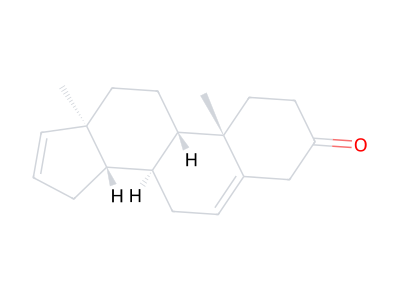
Androstadienone
A1 • Dienone • The Love Pheromone • 4,16-androstadien-3-one • androsta-4,16-dien-3-one
C19H26O CAS: 4075-07-4 270.41 g/mol
Overview
Androstadienone (androsta-4,16-dien-3-one), universally known as "A1" or "dienone" in the pheromone community, is the most scientifically studied human pheromone and one of the most potent romantic molecules available. It is derived from progesterone and pregnenolone and is most commonly found in male perspiration and hair secretions. It is predominantly produced during sleep, which some researchers believe supports its role in strengthening pair bonds between partners.
The community calls it "The Love Pheromone" because of the nature of the feelings it induces: comfort, emotional bonding, longing, and romantic attachment. On the PheroTruth forum, the dedicated androstadienone thread spans 27 pages of discussion -- a testament to how central this molecule is to pheromone practice.
A1 is highly polarizing. It produces powerful romantic effects on women while frequently causing depressive side effects ("the downer") in male wearers. Managing this tradeoff is a major topic of community discussion.
Pharmacology
What It Is
Androstadienone (androsta-4,16-dien-3-one) is a C19 androstadiene steroid with two double bonds (at C-4 and C-16) and a 3-ketone. Molecular formula C₁₉H₂₆O, MW 270.41. The two double bonds make it one of the most volatile pheromone steroids — it readily evaporates from skin and disperses through air. Classified as a "vomeropherin" due to demonstrated VNO stimulation.
Biosynthesis
Endogenous steroid derived from progesterone and pregnenolone:
Cholesterol → Pregnenolone → Progesterone → Androstadienone
It is found predominantly in male perspiration and hair secretions. Notably, production is highest during sleep — researchers believe this supports its role in strengthening pair bonds between sleeping partners. Individual skin bacteria can metabolize androstadienone into androstenone, which fundamentally changes the signal from romantic to sexual/dominant.
Detection
One of the most scientifically validated pheromone detection pathways:
- VNO stimulation — demonstrated electrovomeronasogram responses
- Main olfactory system — consciously perceptible musky scent
- Hypothalamic activation — PET studies (Savic et al., 2001) show gender-specific activation of the medial preoptic area/anterior hypothalamus in women, a region critically involved in sexual and bonding behavior
- Produces measurable physiological changes: relaxation, slower breathing, reduced heart rate, increased skin sensitivity in women
Character
Strong evidence · 125 poststhe heavy comforter
It wraps the room in a deep, emotional blanket of comfort and bonding, but threatens to drag the wearer down into a dark, cortisol-induced depression.
- comforter
- serious imprinter
- depressing juice
- unwanted downer
- shitty feeling
Effect profile PheromoneXS GOALS
- calming2nd7Content
- engaging4Excited
- status2Optimistic
- social5Friendly
- playful2Happy
- flirting4Courageous
- intimateprime8Loving
- sexual5Pleasurable
Where it sits
- BondingDominance
- IntrospectiveOutgoing
- ApproachableIntimidating
- Androgenic
- neutral
- Self-effect
- 8/10
- Timing
- day/night
- Duration
- 6 to 8 hours
Though chemically classified as a non-androgenic steroid, the forum reads its signal as a masculine tool for projecting emotional openness and comfort to women.
Shadow.It triggers a severe depressive crash, lethargy, fatigue, and irritability in the wearer due to cortisol spikes, which can also bleed over to alienate or irritate other men in the vicinity.
Dose.A steep cliff. Highly sensitive to dosage; exceeding a personal threshold quickly turns a comforting experience into a dark, depressive downer.
Works on.Women under high stress, long-term partners, and younger women (ages 15-30) in dating scenarios.
Backfires on.Other men, who may become alienated or irritable, and wearers prone to chronic cortisol arousal or depression.
Stacks with.New Pheromone Additive (NPA), Glace, Corporativo, TUSC, Orbital, Alpha/sexual mixes (to counter the downer)
In their words
Androstadienone is a comforter. It's most useful and effective when Auntie Flo is coming to see your girl, but it is a fine thing to wear anytime there is a lot of stress in her life.
I hate to even write about this molecule in this sort of light cause I love the bonding effect it has and all of my major hits are cause this was always one of the ingredients used for it.
For me the depressive effect is just too much.
Synthesised from archived PheroTruth threads. Every quote is verified verbatim against the post it cites. The archive holds roughly 29% of the forum's posts and over-represents opening posts, so read thin profiles with that in mind.
Community Effect Profile
Multi-dimensional effect ratings from community reports. The shaded area shows variance (standard deviation).
High confidence
— 30 reports
Effects
Effects on Women (Targets)
- Crush induction ("fallout effect"): One of the most consistently reported effects. Women develop a yearning or longing for the wearer with repeated exposure. This can easily create or enhance romantic relationships.
- "Prince Charming" effect: Women in the community report perceiving the wearer as more attractive than they actually are. Scientific studies confirm women rate men as more attractive when exposed to A1.
- Increased affection and physical contact: Makes women feel more affectionate and "cuddly," with a strong desire for physical contact. This is linked to A1 increasing skin sensitivity, leading to more pleasurable sensations from touch.
- Comfort and well-being: Women let go of stress and discomfort, followed by feelings of being content, safe, and protected. Multiple studies document this mood-elevating reaction.
- PMS symptom relief: Community reports and some research suggest A1 eases PMS symptoms and headaches in women.
- Memory imprinting: One of the most distinctive effects. A1 has been shown to create long-term memory effects in women -- they think about the wearer more, remember conversations more vividly, and recall things the wearer said and did. Over time, this shifts perception of the wearer into a romantic light.
- Emotional amplification: A1 appears to enhance awareness of internal feelings. Since women are naturally emotionally attuned, this creates a powerful amplifier effect on whatever emotional state is already present.
Self-Effects on Male Wearers
- Mood elevation (especially in the presence of women)
- Enhanced emotional awareness and sensitivity
- Depression / "the downer": The most widely discussed side effect. Many men experience lethargy, anxiety, depression, and a sense of "impending doom" from A1 exposure. Some describe it as "talking yourself out of going out to meet women." This effect is dose-dependent and varies significantly between individuals.
- Vivid or unusual dreams: Users report A1 causing more vivid or "weird" dreams.
- Irritability at overdose levels: At 3+ sprays of A1-heavy products like Erox, users report classical A1 overdose symptoms including irritability.
Dosage Guidelines
| Level | Amount |
|---|---|
| Light | 5-15 mcg |
| Moderate | 15-40 mcg |
| Strong | 40-100 mcg |
Important notes:
- Alchemy Labs sold A1 at 10 mcg per drop; experienced users like as33156 used it at this concentration as the base for every mix.
- Extreme doses (200+ mcg per drop) are warned to cause depressive "crashes."
- Start low to assess your sensitivity to the depression side effect before increasing.
- Oil-based A1 (e.g., Cohesion) causes less depression than alcohol-based due to slower diffusion.
- Best used in combination with other molecules rather than solo (solo use is most effective in intimate/romantic settings).
Managing the Depression Side Effect
Community-tested strategies from the PheroTruth thread "A tip to counter Androstadienone downer" (rated 8/10 quality):
- Layer order matters: Apply sexual/alpha pheromones to the neck FIRST, wait 2 minutes, then apply A1. This significantly reduces the downer.
- Use oil-based formulations: Oil-based A1 (e.g., Cohesion) causes milder depression due to slower diffusion compared to alcohol-based sprays.
- Apply lanolin lotion barrier: Applying lanolin lotion before oil-based pheromones creates a barrier that reduces skin absorption and subsequent lethargy.
- Spray on clothes, not skin: Spraying alcohol-based A1 on clothing instead of skin reduces the downer effect while still delivering hits to targets.
- Buffer with other molecules: Low-dose androstadienol (TAH, 2.5 mcg) combined with androstadienol (TAL) is suggested as a depression-free alternative to pure A1.
Combinations
Recommended Stacks
- A1 + Androsterone: Romantic authority -- bonding with respect.
- A1 + Alpha Androstenol: Warm, conversational bonding. A classic pairing.
- A1 + Androstenone: Sexual + romantic (careful with ratios to avoid overwhelming targets).
- A1 + Xist + Evolve: Creates "surreal" levels of attraction. Xist requires cumulative exposure (3-4 hours over 8-10 sessions) to manifest significant behavioral changes.
- Voodoo + NNPA + A1: Promising combo for social/bar environments. Makes whatever the wearer says seem like "GOLD" in social situations.
- Alfa Maschio + Glace + A1: Recommended as safe and effective for corporate boardroom settings.
- Certo + Cohesion: Suggested as a smoother alternative to True Love for those sensitive to the A1 downer.
Combinations to Avoid
- A1 + Copulins: Multiple users report this does not combine well. Some gain benefit, but many find the combination counterproductive.
- Excessive A1 in heavy mixes: Mixes with TA, TI, A1, WAGG, and TAA together can cause extreme attention and blatant staring from strangers -- overwhelming rather than useful.
The Imprinting Effect
A1 is uniquely associated with "imprinting" -- where repeated exposure creates lasting positive associations:
- Use consistently with the same target over multiple interactions
- Works best in repeated, cumulative exposure contexts
- Builds a compounding romantic effect over time
- Xist leverages this mechanism specifically ("Friendzone Killer")
- Warning: Do not use around women you are not romantically interested in, as it can cause unwanted crushes and resulting social complications.
Application Tips
Best Application Points
- Neck / behind ears
- Wrists
- Chest (under clothing)
- Forearms
Timing
- Apply 15-30 min before social interaction
- Reapply every 4-6 hours if needed
- Morning application works for all-day wear
Avoid
- Applying immediately before close contact
- Using strong cover scents that mask effect
- Applying to clothing (oils can stain)
Have experience with Androstadienone? Share your dosage notes in the Community tab.
Share Experience →Research Overview
Scientific studies and research related to Androstadienone. Search PubMed for CAS 4075-07-4 for more studies.
Related Articles on Pheromaxxing
Guides, science articles, and techniques that discuss Androstadienone.
Stacking Principles: Combining Pheromones Effectively
Recognizing and Recovering from Pheromone Overdose
GABA-A Receptor Modulation by Neurosteroids
How Pheromones Affect Stress: Cortisol and the HPA Axis
Do Human Pheromones Exist? The Scientific Evidence
Olfactory vs VNO: Parallel Detection Pathways
The Wyart Study: Androstadienone Effects on Women's Mood and Cortisol
OR7D4: The Gene That Determines How You Smell Androstenone
Androstane Nomenclature and Stereochemistry
What VNO Science Means for Pheromone Users
Outcome Independence: Detachment From Results
Pheromone Stacking: The Complete Ratios Guide
Understanding and Leveraging Social Proof
Approach Strategies: Real-World Application
Key Findings
Summary of important research findings related to Androstadienone.
Research Summary Coming Soon
We're compiling peer-reviewed research on Androstadienone. In the meantime, use the search links above to find published studies.
Want to contribute? If you know of relevant studies, share them in the Community tab.
Research Context
Detection Studies
Research on how humans detect this compound, including olfactory receptor studies and perception genetics (e.g., OR7D4 variants).
Learn about detection →Behavioral Studies
Studies examining behavioral and psychological effects of exposure, including mood, attraction, and social behavior changes.
Browse studies →Receptor Biology
Research on receptor binding, including GABA-A modulation, steroid receptor interactions, and neural signaling.
Learn about receptors →Know of relevant research?
Help us build the most comprehensive pheromone research database.
Share a Study →Products Containing Androstadienone
Commercial pheromone products that include Androstadienone in their formula.
Buying Guide
Concentration Matters
Products vary widely in Androstadienone concentration. Higher isn't always better — check dosage guidelines on the Effects tab.
Formula Synergy
Androstadienone is often combined with other molecules. The overall formula balance affects the final effect more than any single ingredient.
Vendor Reputation
Stick to established vendors with verifiable lab testing. Check vendor pages for community reputation and reviews.
DIY Option
For experienced users, raw Androstadienone is available from some vendors.
Raw Materials
Raw pheromone molecules can be purchased and diluted in carrier oils (DPG, alcohol, etc.) for custom formulations.
Note: DIY requires precise measurement equipment and knowledge of safe concentrations. Start with pre-made products.
Know of a product containing Androstadienone?
Help us build the most complete product database.
Suggest a Product →No community experiences yet for Androstadienone.
Click anywhere on the wall to leave the first mark.
click anywhere to leave a mark