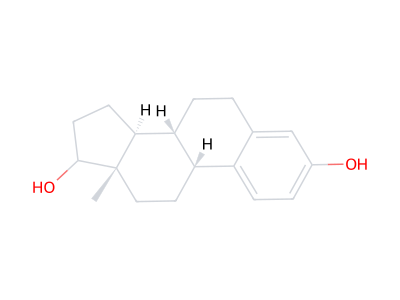
Estratetraenol
EST • The Nurturing/Protective Pheromone • Estra-1,3,5(10),16-tetraen-3-ol
C18H22O CAS: 1150-90-9 254.37 g/mol
Overview
Estratetraenol (estra-1,3,5(10),16-tetraen-3-ol) is a putative female pheromone found in female sweat and pregnant woman's urine. It's structurally related to estrogens but has NO estrogenic activity due to the C16=C17 double bond replacing the 17β-hydroxyl group.
The community is divided on its usefulness, with some viewing it as a comfort enhancer and others arguing it signals "pregnancy" and kills sexual attraction.
Pharmacology
What It Is
Estratetraenol (estra-1,3,5(10),16-tetraen-3-ol) is a C18 estratetraene steroid — an estrane skeleton with four double bonds (at C1-C2, C3-C4, C5-C10, and C16-C17), plus a 3-hydroxyl (phenolic OH). Molecular formula C₁₈H₂₂O, MW 254.37. Despite being structurally related to estrogens, it has NO estrogenic activity — the C16=C17 double bond replaces the 17β-hydroxyl group that is essential for estrogen receptor binding.
Biosynthesis
Estratetraenol is found in female sweat and pregnant women's urine, consistent with its characterization as a putative female pheromone. Its biosynthetic pathway is not fully elucidated but it is derived from the estrane/estrogen pathway:
Cholesterol → Pregnenolone → DHEA → Androstenedione → Estrone → Estratetraenol
                                                                  (via 16-dehydration)
Detection & Chemistry
Detected via VNO (close-range, non-volatile). The 16-position double bond is chemically critical:
- Replaces the 17β-OH required for estrogen receptor binding → non-estrogenic
- Any compound marketed as "estratetraenone" with a 16-double bond is chemically impossible — the C17 ketone position is occupied by the double bond
- The aromatic A-ring (phenol) provides some polarity, limiting volatility
Detection Pathway
Estratetraenol is non-volatile (no vapor pressure data available, estimated very low). Detection is likely through:
- VNO pumping mechanism: Mucus transport of non-volatile compounds
- Direct contact: Close-proximity interactions
This explains why effects are primarily seen in intimate/close settings rather than diffusively.
Related Compounds
| Compound | CAS | Difference |
|---|---|---|
| Methoxyestratetraenol (MEO-EST) | 28336-31-4 | Methyl ether - more potent, non-prodrug |
| Estratetraenol acetate | Unknown | Acetate ester - prodrug form |
| 8,9-Dehydroestrone | 474-87-3 | DIFFERENT - horse estrogen, IS estrogenic |
Important Warnings
Mislabeling Issues
Many vendors sell "estratetraenone" which is chemically problematic:
- The 16-position double bond precludes a 17-ketone
- May actually be 8,9-dehydroestrone (horse estrogen, IS estrogenic)
- Or mislabeled methoxyestratetraenol
- Always verify CAS numbers
Not for HRT
Despite the name similarity to estrogens, estratetraenol has zero estrogenic activity and is not suitable for hormone replacement.
Character
Moderate evidence · 29 poststhe vulnerable sweetheart
Wearing this wraps you in a protective, comforting aura that makes others treat you with gentle, non-sexual care and nurturing concern.
- the love scent
- vulnerable and sensitive
- nurturing/hand holding
- paternalistic
- feel good thing
- pregnant womans scent
- disinhibition
Effect profile PheromoneXS GOALS
- calmingprime7Content
- engaging4Excited
- status0Optimistic
- social2nd6Friendly
- playful3Happy
- flirting2Courageous
- intimate5Loving
- sexual1Pleasurable
Where it sits
- BondingDominance
- IntrospectiveOutgoing
- ApproachableIntimidating
- Androgenic
- feminine
- Self-effect
- 5/10
- Timing
- day/night
- Duration
- 2 to 3 hours
It is produced naturally by child-bearing women and is read as a highly feminizing signal that can confuse male wearers' sexual presentation.
Shadow.Can trigger hostile reactions if not in the right blend, or cause partners to completely ignore the wearer, stripping away sexual attraction in favor of a non-sexual, protective 'pregnant woman' caretaking vibe.
Dose.Can be touchy; too much can cause separation/bitter taste in DIY lip gloss, or trigger hostility/complete ignoring from partners if overdosed, though some report success upping the dose for intimate settings.
Works on.Husbands/partners in intimate, relaxed settings, or in predominantly male environments for extra compliance or protection.
Backfires on.Men seeking direct sexual/alpha attraction from women (who may view them as non-sexual or 'pregnant'), or partners who are highly sensitive to it and react with hostility or total avoidance.
Stacks with.copulins, Androstadienone, Corporativo, TAH
In their words
This product does give women the feeling of caring but not sexual caring. It's more like watching over the pregnant lady and making sure she is OK.
I usually don’t get self effects from Pheromones, but I want to say that I felt more vulnerable and sensitive sometimes when I wore EST.
Haha TT gets has a hostile reaction to est. if it's not in the right blend !
Synthesised from archived PheroTruth threads. Every quote is verified verbatim against the post it cites. The archive holds roughly 29% of the forum's posts and over-represents opening posts, so read thin profiles with that in mind.
Community Effect Profile
Multi-dimensional effect ratings from community reports. The shaded area shows variance (standard deviation).
Moderate confidence
— 7 reports
Effects
Effects on Others (Targets)
- Mood boosting and "feel good" energy: People exposed to EST instantly get a brighter disposition and feel uplifted, energized, and more social in the wearer's presence.
- Nurturing/protective response from men: When worn by women, men feel they need to protect the wearer, perceiving them as vulnerable. Men act more chivalrous and affectionate. Note: some men find the vulnerability signal irritating rather than attractive.
- Comfort and warmth signals: Non-sexual warmth and caring perception.
- Femininity amplification: Can make women feel adored, more "girly," and more ditsy. Not necessarily negative but can reduce status perception in professional environments at high doses.
- Buffer against aggression: Used in extremely small doses in male pheromone formulas to offset aggressive alpha molecules.
Effects When Worn by Men
- Excellent mood booster and stress reliever: In small doses, men find EST to be a genuine "feel good" molecule.
- Warning -- weakness signals: In early testing by HoP, men wearing EST found that others tried to "protect" them from normal banter, perceiving them as unable to handle it. For men, giving off weak signals is not attractive.
- Vulnerability perception: Men may be perceived as physically weaker and more womanly.
Controversy: The Pregnancy Signal Theory
Some community members (notably Paradox on the forums) argue that EST signals pregnancy and therefore reduces sexual attraction. The theory:
- Pregnant women produce EST
- Male response to pregnancy = protection, not sexual interest
- Therefore EST "friendzones"
Counter-argument: Others find it useful as a comfort buffer that creates trust without the romantic intensity of androstadienone. The HoP perspective is that EST is a legitimate female pheromone with real nurturing and protective effects, not just a pregnancy signal.
Dosage Guidelines
| Level | Amount |
|---|---|
| Light | 3-15 mcg |
| Moderate | 15-40 mcg |
| Strong | 40-80 mcg |
Notes:
- Primarily used at trace amounts (3 mcg range) as an aggression buffer in male blends
- Higher doses (15+ mcg) are more typical for women's use
- Best used in combination, not solo
- Higher doses may emphasize "comfort zone" effect
Application Tips
Best Application Points
- Neck / behind ears
- Wrists
- Chest (under clothing)
- Forearms
Timing
- Apply 15-30 min before social interaction
- Reapply every 4-6 hours if needed
- Morning application works for all-day wear
Avoid
- Applying immediately before close contact
- Using strong cover scents that mask effect
- Applying to clothing (oils can stain)
Have experience with Estratetraenol? Share your dosage notes in the Community tab.
Share Experience →Research Overview
Scientific studies and research related to Estratetraenol. Search PubMed for CAS 1150-90-9 for more studies.
Related Articles on Pheromaxxing
Guides, science articles, and techniques that discuss Estratetraenol.
Key Findings
Summary of important research findings related to Estratetraenol.
Research Summary Coming Soon
We're compiling peer-reviewed research on Estratetraenol. In the meantime, use the search links above to find published studies.
Want to contribute? If you know of relevant studies, share them in the Community tab.
Research Context
Detection Studies
Research on how humans detect this compound, including olfactory receptor studies and perception genetics (e.g., OR7D4 variants).
Learn about detection →Behavioral Studies
Studies examining behavioral and psychological effects of exposure, including mood, attraction, and social behavior changes.
Browse studies →Receptor Biology
Research on receptor binding, including GABA-A modulation, steroid receptor interactions, and neural signaling.
Learn about receptors →Know of relevant research?
Help us build the most comprehensive pheromone research database.
Share a Study →Products Containing Estratetraenol
Commercial pheromone products that include Estratetraenol in their formula.
No Products Listed Yet
We're still cataloging products containing Estratetraenol. Check back soon or browse all vendors to find products manually.
Browse All Vendors →Buying Guide
Concentration Matters
Products vary widely in Estratetraenol concentration. Higher isn't always better — check dosage guidelines on the Effects tab.
Formula Synergy
Estratetraenol is often combined with other molecules. The overall formula balance affects the final effect more than any single ingredient.
Vendor Reputation
Stick to established vendors with verifiable lab testing. Check vendor pages for community reputation and reviews.
DIY Option
For experienced users, raw Estratetraenol is available from some vendors.
Raw Materials
Raw pheromone molecules can be purchased and diluted in carrier oils (DPG, alcohol, etc.) for custom formulations.
Note: DIY requires precise measurement equipment and knowledge of safe concentrations. Start with pre-made products.
Know of a product containing Estratetraenol?
Help us build the most complete product database.
Suggest a Product →No community experiences yet for Estratetraenol.
Click anywhere on the wall to leave the first mark.
click anywhere to leave a mark