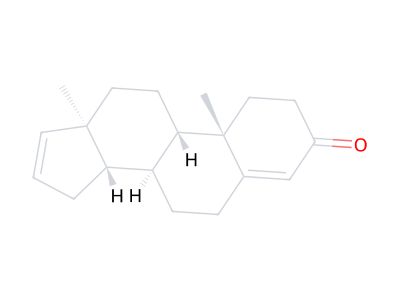
Androstenone
None • Enone • The Sexual Pheromone • 5a-androst-16-en-3-one
C19H28O CAS: 18339-16-7 272.43 g/mol
Overview
Androstenone (5a-androst-16-en-3-one), commonly called "None" or "Enone" in the community, is the most powerful sexual attraction pheromone currently known. It is responsible for the characteristic "boar taint" smell in pork and is one of the most studied human pheromones.
The community calls it "The Sexual Pheromone" because of its dominant presence and aura of sexual prowess. Scientific studies have confirmed it raises arousal levels in women, and it remains one of the core components in most modern pheromone formulas. It is also one of the most notoriously easy molecules to overdose.
Androstenone projects an aura of a healthy, attractive male with excellent reproductive capabilities. Higher testosterone levels lead to higher androstenone excretion through sweat, meaning levels can be raised naturally through proper exercise and nutrition.
Perception Genetics
Androstenone perception is determined by the OR7D4 olfactory receptor gene:
| Genotype | Perception |
|---|---|
| Functional OR7D4 | Unpleasant, sweaty, urine-like |
| Partially functional | Neutral or musky |
| Non-functional | Cannot smell it (anosmic) |
Approximately 50% of people find androstenone unpleasant, 35% neutral, and 15% pleasant. Notably, the scent of androstenone is more attractive to more sexually experienced women, per published research.
Pharmacology
What It Is
Androstenone (5α-androst-16-en-3-one) is a C19 androstene steroid — an androstane skeleton with a double bond at the C-16 position and a ketone at C-3. Molecular formula C₁₉H₂₈O, MW 272.43. The 16-ene double bond is the key structural feature: it makes the molecule significantly more volatile than saturated androstanes, allowing it to evaporate from skin and travel through air.
Biosynthesis
Androstenone is an endogenous steroid produced from testosterone metabolism:
Testosterone → DHT → 5α-Androst-16-en-3-one (Androstenone)
It is secreted through apocrine sweat glands in the axillae (armpits), scalp, and groin. Production correlates directly with testosterone levels — higher T = more androstenone. It is also a major component of boar saliva and is responsible for "boar taint" in pork, which is how it was first identified as a mammalian pheromone.
Detection
Androstenone is detected via both VNO and the main olfactory system:
- The 16-ene double bond gives it enough volatility to reach the nose (unlike saturated androstanes)
- Consciously perceptible — described as musky, urine-like, or sweaty depending on genetics
- Ability to smell it is determined by the OR7D4 olfactory receptor gene (see Perception Genetics above)
- Disperses readily in air — effective diffusive range is greater than most other pheromone molecules
Note: There is also a Delta-2 isomer (delta-2-androstenone) discussed on PheroTruth, with a different double bond position. Community testing data on this variant remains limited.
Character
Strong evidence · 39 poststhe polarizing heavy hitter
A high-risk, high-reward sexual dominant that commands raw attraction but easily triggers intimidation, anxiety, or aggression if unbuffered.
- porn for the subconscious mind
- over attraction
- walking sex
- urinous odor
- smell like a pig
- big evil alpha guy
Effect profile PheromoneXS GOALS
- calming0Content
- engaging4Excited
- status2nd7Optimistic
- social2Friendly
- playful1Happy
- flirting6Courageous
- intimate2Loving
- sexualprime8Pleasurable
Where it sits
- BondingDominance
- IntrospectiveOutgoing
- ApproachableIntimidating
- Androgenic
- masculine
- Self-effect
- 7/10
- Timing
- night
- Duration
- several hours
Universally viewed as a highly masculine testosterone metabolite associated with dominant male status and aggression.
Shadow.An overdose triggers severe negative reactions: women become aroused but completely uninterested, while other men become highly aggressive, dismissive, or challenging.
Dose.Highly steep and unforgiving; a slight increase in dosage easily crosses the line from raw attraction into intimidation, anxiety, and social friction.
Works on.High-energy nightlife environments like bars and clubs, and on fertile women during their conceptive optimum.
Backfires on.Workplaces, formal dinners, and around women who are not in their fertile cycle phase or who lack established comfort with the wearer.
Stacks with.Androstadienone (to buffer the harshness and add comfort/emotional depth), Beta Androstenol (to add social connection and charm), Erox / ER303 (to direct sexual excitement towards the wearer), Androsterone (to build a masculine leader vibe for status)
In their words
Androstenone, what can I say? It's porn for the subconscious mind. You never know what you'll get. Stimulation? Fear? Anger? Guilt? some mix of all of the above?
sometimes I put on 3 drops of AV and I want to get into a bar fight, I want to approach, i walk tall with a baseball bat in my hands,it's intense.
It sounds like you conclusively used too much Androstenone and had reactions very stereotypical of doing so - women aroused but not interested, men aggressive or dismissive.
Synthesised from archived PheroTruth threads. Every quote is verified verbatim against the post it cites. The archive holds roughly 29% of the forum's posts and over-represents opening posts, so read thin profiles with that in mind.
Community Effect Profile
Multi-dimensional effect ratings from community reports. The shaded area shows variance (standard deviation).
Moderate confidence
— 8 reports
Effects
Effects on Women (Targets)
- Sexual arousal and attraction: The primary effect. Women find men with higher levels of androstenone far more attractive. Scientific studies confirm raised arousal levels.
- Significant increase in touching, kissing, and sexual advances: One of the most consistently reported effects from community testing.
- "Bad boy" / dominant perception: Creates an attractive "vibe" that reads as dominant, confident, and sexually capable. Can be perceived as a "jock-like" presence.
- Intimidation at high doses: Some women, particularly younger women, may find high-dose androstenone intimidating or off-putting rather than attractive.
- Alpha status perception: Men may also perceive the wearer as someone of higher social, sexual, and alpha status.
Community User Reports
- Ancillian (PheroTruth) reported using Primal Instinct (androstenone-only product) at age 19: "Got nice results from women who were older than me in the 25-40 age range -- initiating conversations with me and being visibly distracted by my presence." He noted his short, unintimidating-looking physique may have benefited from the alpha status boost.
- Build-up effect: Aged/built-up androstenone on skin produces a "sexual hit" vibe that lacks the typical intimidation of freshly applied androstenone.
Negative Effects at High Doses
- Men acting aggressively toward the wearer: Other males perceive the androstenone signal as a competitive threat.
- Women acting rude or finding you "creepy": The classic overdose symptom.
- Fear-based respect that backfires: Instead of attraction, targets feel threatened.
- "Creep factor" if the androstenone signal is incongruent with the wearer's behavior and appearance.
Self-Effects
- Heightened sense of confidence and dominance
- Can increase aggressive or competitive feelings
- Some users report improved posture and body language
Dosage Guidelines
| Level | Amount |
|---|---|
| Light | 1-5 mcg |
| Moderate | 5-15 mcg |
| Strong | 15-30 mcg |
Critical notes from the community:
- Most overdosed molecule in the community -- less is almost always more.
- Alfa Maschio contains 10 mcg of androstenone per spray, which can be too aggressive for some users. The developer cautions: "I would stick with one spray at 20 mcg Androstenone. Two is a lot, even for me."
- Must be balanced with social molecules (androstenol, androsterone) to avoid negative reactions.
- Test with trusted feedback before social deployment.
- Requires a strong cover scent at higher concentrations due to the perceptible musky/urine-like odor.
- Best suited for high-competition environments (nightclubs, bars, parties). Not recommended in high doses for professional environments.
Removal Tips
- Soap and water often fail to remove silicone-based androstenone products (especially Alpha Dream formulations).
- Witch hazel and hydrogen peroxide are recommended for residue removal.
Combinations
Essential Stacks
- Androstenone + Alpha Androstenol: The classic balance -- aggression buffered with friendliness and approachability.
- Androstenone + Androsterone: Authority without intimidation. The respect molecule smooths out the rough edges.
- Androstenone + Androstadienone: Sexual + romantic layering. Careful with ratios to avoid overwhelming the target.
- Androstenone + DHEAS: DHEAS acts as a "none blocker" or temperant for androstenone, reducing the aggressive edge while maintaining the sexual signal.
- 2x Neroli AMMO + Androstenone + Androsterone: A blend approach that adds direction to social effects.
Danger Zones
- Solo androstenone at high doses = "creepy vibe" -- always buffer.
- High androstenone + high androstadienone = emotional overload for both wearer and targets.
- Androstenone without social buffers = pure intimidation with no approachability.
- Too much androstenone makes other men aggressive and scares/chases away younger women.
Application Tips
Best Application Points
- Neck / behind ears
- Wrists
- Chest (under clothing)
- Forearms
Timing
- Apply 15-30 min before social interaction
- Reapply every 4-6 hours if needed
- Morning application works for all-day wear
Avoid
- Applying immediately before close contact
- Using strong cover scents that mask effect
- Applying to clothing (oils can stain)
Have experience with Androstenone? Share your dosage notes in the Community tab.
Share Experience →Research Overview
Scientific studies and research related to Androstenone. Search PubMed for CAS 18339-16-7 for more studies.
Related Articles on Pheromaxxing
Guides, science articles, and techniques that discuss Androstenone.
Getting Started with Pheromones: A Beginner's Guide
Stacking Principles: Combining Pheromones Effectively
Recognizing and Recovering from Pheromone Overdose
GABA-A Receptor Modulation by Neurosteroids
How Pheromones Affect Stress: Cortisol and the HPA Axis
Do Human Pheromones Exist? The Scientific Evidence
Olfactory vs VNO: Parallel Detection Pathways
OR7D4: The Gene That Determines How You Smell Androstenone
Androstane Nomenclature and Stereochemistry
Estratetraene Chemistry: Position Matters
What VNO Science Means for Pheromone Users
VNO Receptor Genetics: V1R and V2R in Humans
State Control: Mastering Your Emotional State
Outcome Independence: Detachment From Results
Pheromone Stacking: The Complete Ratios Guide
Understanding and Leveraging Social Proof
Approach Strategies: Real-World Application
Key Findings
Summary of important research findings related to Androstenone.
Research Summary Coming Soon
We're compiling peer-reviewed research on Androstenone. In the meantime, use the search links above to find published studies.
Want to contribute? If you know of relevant studies, share them in the Community tab.
Research Context
Detection Studies
Research on how humans detect this compound, including olfactory receptor studies and perception genetics (e.g., OR7D4 variants).
Learn about detection →Behavioral Studies
Studies examining behavioral and psychological effects of exposure, including mood, attraction, and social behavior changes.
Browse studies →Receptor Biology
Research on receptor binding, including GABA-A modulation, steroid receptor interactions, and neural signaling.
Learn about receptors →Know of relevant research?
Help us build the most comprehensive pheromone research database.
Share a Study →Products Containing Androstenone
Commercial pheromone products that include Androstenone in their formula.
Buying Guide
Concentration Matters
Products vary widely in Androstenone concentration. Higher isn't always better — check dosage guidelines on the Effects tab.
Formula Synergy
Androstenone is often combined with other molecules. The overall formula balance affects the final effect more than any single ingredient.
Vendor Reputation
Stick to established vendors with verifiable lab testing. Check vendor pages for community reputation and reviews.
DIY Option
For experienced users, raw Androstenone is available from some vendors.
Raw Materials
Raw pheromone molecules can be purchased and diluted in carrier oils (DPG, alcohol, etc.) for custom formulations.
Note: DIY requires precise measurement equipment and knowledge of safe concentrations. Start with pre-made products.
Know of a product containing Androstenone?
Help us build the most complete product database.
Suggest a Product →No community experiences yet for Androstenone.
Click anywhere on the wall to leave the first mark.
click anywhere to leave a mark