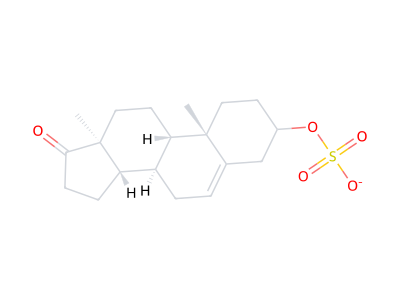
DHEAS
Dehydroepiandrosterone Sulfate • DHEA Sodium Sulfate • Molecule F
C19H28O5S CAS: 651-48-9 368.49 g/mol
Overview
DHEAS (dehydroepiandrosterone sulfate) is the sulfated form of DHEA and the most abundant circulating steroid hormone in the human body. The sulfate group extends its half-life to 7-10 hours (vs DHEA's 15-30 minutes), making it a stable reservoir.
In the pheromone community, DHEAS is known as the "social attention grabber" and was identified as Molecule F during Alpha Dream's blind testing. Users report becoming more verbally articulate, playful, and intellectual. It's described as a "beautifier" with strong sexual enhancement at higher doses.
Pharmacology
What It Is
DHEAS (dehydroepiandrosterone sulfate) is the sulfate conjugate of DHEA — DHEA with a sulfate group (-OSO₃⁻) attached at the 3β-hydroxyl. Molecular formula C₁₉H₂₈O₅S, MW 368.49. It is the single most abundant circulating steroid in the human body, present at concentrations 100-500x higher than free DHEA in the bloodstream.
Biosynthesis
Produced in the adrenal cortex by sulfotransferase SULT2A1:
DHEA + PAPS → DHEAS (via SULT2A1)
The sulfation extends DHEA's half-life dramatically — DHEAS circulates for 7-10 hours (vs 15-30 minutes for free DHEA). Skin sulfatases can reverse this, releasing free DHEA for local conversion to androgens/estrogens. DHEAS levels peak in the 20s and decline with age, mirroring DHEA.
Detection & Mechanism
- Not a classical VNO pheromone — the sulfate group makes it too polar for VNO receptor binding
- Acts as a slow-release reservoir for DHEA — skin sulfatases cleave the sulfate, generating free DHEA that converts to active androgens locally
- Signals immunocompetence and youth — high DHEAS levels indicate low inflammation and a healthy, young endocrine system
- Nootropic effects: crosses the blood-brain barrier, increases hippocampal neurogenesis
Character
Moderate evidence · 20 poststhe unexpected random factor
Wearing this is like injecting an intellectual, highly verbal spark of curiosity that can scale up to a raw, delayed-onset sexual intensity.
- human sex volcano
- Porn Star (Steel, not wood)
- unexpected random factor
- intensely verbal
- light alpha charisma
- nootropic in effects
- Bubbles, excitement
Effect profile PheromoneXS GOALS
- calming2Content
- engaging6Excited
- status4Optimistic
- socialprime7Friendly
- playful5Happy
- flirting5Courageous
- intimate4Loving
- sexual2nd7Pleasurable
Where it sits
- BondingDominance
- IntrospectiveOutgoing
- ApproachableIntimidating
- Androgenic
- neutral
- Self-effect
- 7/10
- Timing
- day/night
- Duration
- Delayed onset of about 10 minutes, with long-lasting diffusion up to the next morning when applied to hair.
Read as unisex and suitable for both genders, offering women a light alpha charisma without excessive masculinity, while acting as a pro-social male pheromone.
Shadow.Systemic skin breakouts and acne at high doses (50+ mcg) regardless of application point, temporary lightheadedness, and potential sunburn-like redness on the neck.
Dose.Highly dose-dependent: low doses (5-10mcg) can feel flat or detracting, mid doses (10-50mcg) spark verbal/intellectual sociality, and high doses (50-400mcg) trigger intense sexual responses but risk systemic acne unless applied to hair.
Works on.Social settings, party mixes, intellectual gatherings, and intimate/sexual scenarios.
Backfires on.Direct skin application at high doses; low doses (5-10mcg) may feel flat or detract from a mix.
Stacks with.Glace, L'uomo Amore, Androsterone-S, New Pheromone Additive, alpha-nol
In their words
At 50mcg, this stuff is a little intense. Had me feeling lightheaded for a while. Once that passed, I felt intensely verbal and really tuned into my surroundings, but also had some extra fluidity in my perception and movement.
I become the human sex volcano.
Another test I ran was adding 50 mcg DHEAs with 5 drops of New Pheromone Additive. 5 drops of the additive would have for sure put me personally in OD but the DHEAS seemed to temper it some and actually overshadow it.
Synthesised from archived PheroTruth threads. Every quote is verified verbatim against the post it cites. The archive holds roughly 29% of the forum's posts and over-represents opening posts, so read thin profiles with that in mind.
Community Effect Profile
Multi-dimensional effect ratings from community reports. The shaded area shows variance (standard deviation).
Moderate confidence
— 4 reports
Effects
Social/Verbal Effects
- Intensely verbal and verbally fluent
- More tuned into surroundings
- Extra fluidity in perception and movement
- Intellectual quality to interactions
- "Nol-like lightness" but more mysterious
- Attention-grabbing effect
- Pro-social yet sexy
Beautifier Effects
- Possible beautifying effects (wearer appears more attractive)
- People interested in wearer but slightly confused/intrigued
- Easy social acceptance, opens people up
Sexual Enhancement (Higher Doses)
At 200-400 mcg, users report:
- Strong sexual enhancement
- "Turned into a porn star" effects
- Delayed sexual effects that enhance into the next morning
- Enhanced intensity of intimate experiences
Self-Effects
- Delayed onset (~10 minutes before effects become apparent)
- Lightness and explorer-like quality
- GABA-A receptor antagonist
- Immunomodulatory signaling
- Crosses blood-brain barrier readily
- Increases neurogenesis in hippocampus
Dosage Guidelines
| Level | Amount |
|---|---|
| Light | 5-10 mcg |
| Moderate | 10-30 mcg |
| Strong | 30-75 mcg |
| Sexual enhancement | 200-400 mcg |
Notes:
- Threshold effect: 5-10 mcg often felt neutral, 15+ mcg is where effects begin
- Apply to hair at high doses (50+ mcg) to avoid acne breakouts
- Can cause lightheadedness at 50 mcg on first exposure
- Duration: 10-12 hours when fixed with monolaurin
- Effects continue into the next morning at higher doses
Side Effects
- Acne breakouts at 50+ mcg (systemic, not localized to application point)
- Lightheadedness at initial higher doses
- Occasional skin redness at application site
Combinations
Recommended Stacks
- DHEAS + Androsterone: Enhanced social effects with authority
- DHEAS + Existing pheromone mixes: Tempers overdose effects, smooths out problematic signals
- DHEAS + Androstenetrione: Beautifier + attention synergy
Notes
- DHEAS works well WITH other mones rather than standalone
- Noted as a "fallout killing" or "naturalizing" molecule - can prevent crush development
- Particularly valued for its ability to moderate and enhance existing blends
Application Tips
Best Application Points
- Neck / behind ears
- Wrists
- Chest (under clothing)
- Forearms
Timing
- Apply 15-30 min before social interaction
- Reapply every 4-6 hours if needed
- Morning application works for all-day wear
Avoid
- Applying immediately before close contact
- Using strong cover scents that mask effect
- Applying to clothing (oils can stain)
Have experience with DHEAS? Share your dosage notes in the Community tab.
Share Experience →Research Overview
Scientific studies and research related to DHEAS. Search PubMed for CAS 651-48-9 for more studies.
Related Articles on Pheromaxxing
Guides, science articles, and techniques that discuss DHEAS.
Key Findings
Summary of important research findings related to DHEAS.
Research Summary Coming Soon
We're compiling peer-reviewed research on DHEAS. In the meantime, use the search links above to find published studies.
Want to contribute? If you know of relevant studies, share them in the Community tab.
Research Context
Detection Studies
Research on how humans detect this compound, including olfactory receptor studies and perception genetics (e.g., OR7D4 variants).
Learn about detection →Behavioral Studies
Studies examining behavioral and psychological effects of exposure, including mood, attraction, and social behavior changes.
Browse studies →Receptor Biology
Research on receptor binding, including GABA-A modulation, steroid receptor interactions, and neural signaling.
Learn about receptors →Know of relevant research?
Help us build the most comprehensive pheromone research database.
Share a Study →Products Containing DHEAS
Commercial pheromone products that include DHEAS in their formula.
Buying Guide
Concentration Matters
Products vary widely in DHEAS concentration. Higher isn't always better — check dosage guidelines on the Effects tab.
Formula Synergy
DHEAS is often combined with other molecules. The overall formula balance affects the final effect more than any single ingredient.
Vendor Reputation
Stick to established vendors with verifiable lab testing. Check vendor pages for community reputation and reviews.
DIY Option
For experienced users, raw DHEAS is available from some vendors.
Raw Materials
Raw pheromone molecules can be purchased and diluted in carrier oils (DPG, alcohol, etc.) for custom formulations.
Note: DIY requires precise measurement equipment and knowledge of safe concentrations. Start with pre-made products.
Know of a product containing DHEAS?
Help us build the most complete product database.
Suggest a Product →No community experiences yet for DHEAS.
Click anywhere on the wall to leave the first mark.
click anywhere to leave a mark